Freedom

An Unfinished Story

20. Jun 2025 - 31 May 2026

About the exhibition

Freedom in today's world - an embattled idea

While people in authoritarian states are fighting for basic freedoms, democracies are debating what freedom even means: was it justified to restrict individual freedoms during the pandemic? Can climate policies dictate which heating systems or cars a person uses? Is a free society compatible with closed borders? Does self-interest take precedence over the common good – or is it the other way around?

In these debates, the term “freedom” is often invoked for opposing agendas. Even the seemingly unambiguous demands made by historical freedom movements, as well as the symbols they used, are now being appropriated by right-wing populist groups radically opposed to a free, liberal society.

To gain a better understanding of this convoluted conflict, the exhibition first looks to the past. Beginning with the quest for liberation in the major revolutions since the 18th century, the exhibition tells freedom’s unfinished story. Central to this narrative are the dissident movements in Poland, Czechoslovakia, and East Germany before and after 1989. How were they similar? How did they differ? And how do their ideals of freedom continue to resonate with us today?

An exhibition by the Deutsches Hygiene-Museum in cooperation with the European Solidarity Centre, Gdańsk, the National Gallery Prague and the National Museum, Wroclaw

Visit


  • Ticket 12 € / reduced: 6 € / under 17: free
  • Book a tour: service@dhmd.de, +49 (351) 4846-400 (Tue - Fri, 9-12 a.m. & 1-2 p.m.)

Audioguide


Our audio guide in German, English, Polish and Czech introduces the exhibition and presents important exhibits. The objects are commented on by people whose knowledge or personal experiences offer new perspectives and link the exhibits to current issues surrounding the theme of freedom.

to audio guide

Press room


Press Room

Gallery

Chapters

Historisches Gemälde des Dreigespanns „Republik“, „Wahrheit“ und „Wohlstand“ in den französischen Nationalfarben neben dem antiken Philosophen Diogenes.

Symbols of freedom

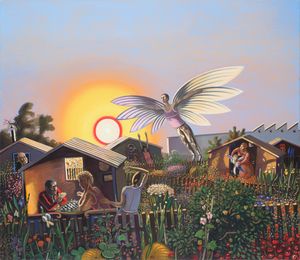
Lady Liberty, the Statue of Liberty in New York, is probably one of the most famous symbols of freedom – but it is by no means the only one! Art history is full of motifs where freedom conquers tyranny or brings hope. The exhibition uses these images, which are still so influential today, to show how artists have given shape to the ideals of freedom.

Schwarzweißaufnahme von zwei Männern und einer Frau am Küchentisch, links im Bild eine Hand, die mit abwehrender Geste eine Zigarette hält.
The journalist Petr Uhl, the civil rights activist Anna Šabatová and the future President of the ČSSR Václav Havel Bohdan Holomíček (* 1943), 1984, Photography, © Bohdan Holomíček

Crafting a liberation

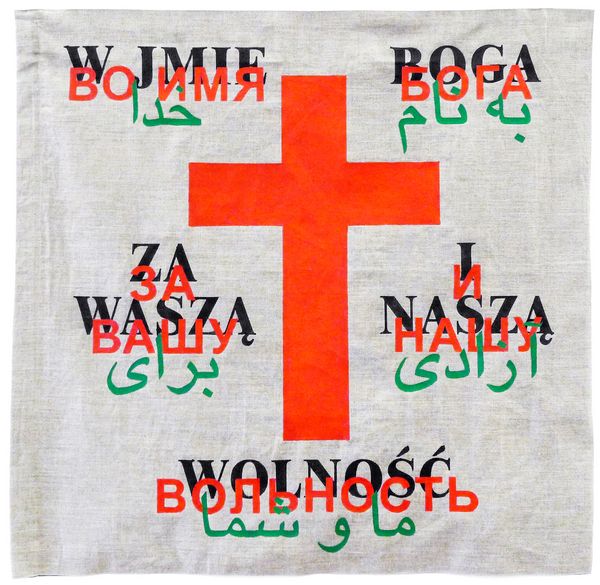
What strategies and activities did the freedom movements in Poland, the Czech Republic and the GDR use to pursue their goal of overcoming the socialist systems of rule? The focus here is on civil rights activists and intellectuals such as Václav Havel in the former ČSSR, the Polish trade union Solidarność with its leader Lech Wałęsa, and the opposition and dissident scene in the GDR. The exhibition traces the key stages of their long journey to freedom: from international agreements on freedom of expression, to social and artistic protests, to round table negotiations, and finally the first free elections.

Eine weiße, quadratische Fahne mit einem roten Kreuz und Begriffen auf Polnisch (darunter Wolnosc), Kyrillisch und Arabisch.
In the Name of God Slavs and Tatars, 2013, Linen cotton wool, acrylic paint Courtesy the Artists; Kraupa-Tuskany Zeidler

Freedom and solidarity

No freedom without solidarity – what remains of this rallying cry of the Eastern and Central European liberation movements? Even today, there are ongoing debates on how to balance the right to self-fulfilment, respect for the freedom of others and the goals of society as a whole. Can looking back at the years before and after 1989 be a source of inspiration for a more cohesive society, both today and in the future? Video interviews from the three countries, together with contemporary artworks and media installations, offer the audience the opportunity to engage intensively with these questions.

Ausstellungsbereich Gemeinschaft mit eine großflächigen Fotografie des August-Streiks 1980 auf der Danizger Werft und mehren Dokumenten und Kunstwerken zur Solidarność

Artists

The exhibition presents not only historical works of art but also contemporary works by artists from Poland, Czechia, and Germany, some of which come from the collections of the cooperating museums in Wrocław and Prague. Artists represented include Pawel Althamer, Frédéric A. Bartholdi, Josef Čapek, Grupa Luxus, John Heartfield, Sven Johne, Krištof Kintera, Cristina Lucas, Wolfgang Mattheuer, Karel Miler, Ewa Partum, Tomasz Sarnecki, Anton Shebetko, Igor Simić, Slavs and Tatars, Gabriele Stötzer, Tracey Snelling and Artur Żmijewski

Interactive stations

At several places in the exhibition, visitors are invited to actively let their thoughts run free. This can be taken literally, for example, at the “marble run”, where your ideas about freedom can roll in a ball and be inspired by the thoughts of other visitors. A “freedom barometer” allows you to measure how free you feel – also in comparison to others. And if you’re feeling brave and have some acting talent, you can recite historical speeches yourself in a “freedom karaoke”.

Guided tours

Public tours

  • Every 2 weeks on Saturdays, 3 p.m.
  • In German
  • recommended from 12 and over, no registration required
  • Free with museum ticket
     

How free do you feel?

Bookable for groups

  • for groups – also in Czech and Polish
  • ca. 1h
  • Book a tour: service(at)dhmd.de, Tel. +49 (351) 4846-400

Project participants

Patronage
The Federal Government Commissioner for Culture and the Media

Curatorial Team
Dr Viktoria Krason, Philipp Bürger, Kathrin Haase, Laura Schmidt, Bettina Beer

Exhibition Design

Kooperative für Darstellungspolitik, Berlin
Distaff Studio, Berlin

Partners
The exhibition was created in cooperation with the European Solidarity Centre in Gdansk, the National Gallery in Prague and the National Museum in Wroclaw. We would like to thank all our co-operation partners for their extraordinary commitment and expertise. The exhibition would not have been possible without the generous loan of numerous outstanding works of art from the collections of the National Museum in Wroclaw and the National Gallery in Prague as well as numerous historical artefacts from the ECS.

Partners

Sponsors